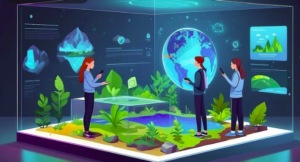
In an era where screens dominate our daily lives, leveraging technology for environmental education has become imperative. Educational games have emerged as a powerful tool, seamlessly blending entertainment with learning to engage and educate users of all ages. As the world increasingly recognizes the importance of preserving natural resources, the intersection of gaming platforms and environmental education offers a promising avenue for fostering awareness and action.
Environmental education has traditionally been delivered through textbooks and classroom lectures, often failing to captivate the attention of today’s digitally savvy generation. However, the advent of educational technology has revolutionized this landscape, paving the way for immersive learning experiences through gaming.

Gaming platforms serve as dynamic environments where digital art and interactive learning converge to create engaging educational experiences. By harnessing the power of gamification, complex concepts related to natural resources and environmental conservation can be simplified and made accessible to a broader audience. Through carefully crafted game development, players are not only entertained but also gain valuable insights into environmental challenges and solutions.
One notable trend in this space is the integration of digital currency and NFTs (Non-Fungible Tokens) into educational games. These innovations not only add an element of excitement but also provide tangible rewards for players who actively participate in the learning process. By incorporating digital art and collectibles, game developers enhance the overall user experience while incentivizing engagement and knowledge retention.
One such example of the successful fusion of gaming and environmental education is the rise of adaptation games. These games simulate real-world scenarios where players must navigate challenges such as climate change, habitat loss, and resource management. By placing users in the role of decision-makers, adaptation games foster critical thinking and empower individuals to explore innovative solutions to environmental issues.
Central to the effectiveness of educational games is their accessibility. Technology platforms have made it easier than ever for users to access gaming content from anywhere in the world. Whether on a smartphone, tablet, or computer, educational games offer a flexible learning experience that can adapt to the needs and preferences of diverse audiences. This easy access ensures that environmental education is not confined to the classroom but can reach individuals across geographical and cultural boundaries.
Moreover, the evolving landscape of gaming platforms continues to drive innovation in the realm of environmental education. With advancements in augmented reality (AR) and virtual reality (VR) technologies, users can immerse themselves in virtual environments that replicate natural habitats and ecosystems. This immersive approach enhances the educational experience by allowing users to interact with digital representations of real-world phenomena, fostering a deeper understanding and appreciation of natural resources.

As the demand for educational games grows, so too does the need for effective game development strategies. Game developers play a crucial role in shaping the user experience and ensuring that educational objectives are met. By leveraging data analytics and user feedback, developers can refine their games to better align with the needs and preferences of their target audience. This iterative process of refinement ultimately leads to more engaging and impactful educational experiences.
In conclusion, the convergence of gaming platforms and environmental education holds immense potential for promoting awareness and stewardship of natural resources. Through educational games, users can explore complex environmental concepts in a fun and interactive manner, fostering a sense of connection and responsibility towards the world around them. By harnessing the power of digital art, interactive learning, and gamification, we can transform pixels into tools for preservation, paving the way for a more sustainable future.